Learning How to Implement Sustainability in Your Business


Why Sustainable Cleaning is the Future (Part 2 of 2):
Learning How to Implement Sustainability in Your Business
By Steve Ashkin, CEO The Ashkin Group and Co-Chair of ISSA’s Sustainability Committee
In my first article on Sustainable Cleaning, we defined sustainable cleaning as protecting human health, caring for the planet, and supporting workers. It is also about meeting customer expectations and preparing for emerging regulatory requirements. Which means, sustainability is good business—it improves efficiency, reduces costs, reduces risk, and helps service providers stand out in a competitive market.
One of the most effective ways to reduce waste is utilizing high-performing equipment to deliver benefits across three areas:
- Energy Savings:
Efficient motors use less electricity, and faster cleaning reduces overall building operating time. When cleaning is completed sooner, lighting and HVAC systems can be reduced earlier—generating significant energy savings beyond the equipment itself.
- Labor Efficiency:
Labor represents 80–90% of cleaning costs. Advanced tools, such as backpack vacuums, can clean three to five times faster than traditional equipment. This allows organizations to improve productivity, reduce wasted effort, and remain competitive while maintaining fair wages and service quality.
- Asset Protection:
Effective cleaning removes abrasive dirt that damages floors and carpets. Extending the life of flooring reduces waste and lowers total cost of ownership by avoiding premature replacement and reducing capital expenditures.
Protecting the Human Body
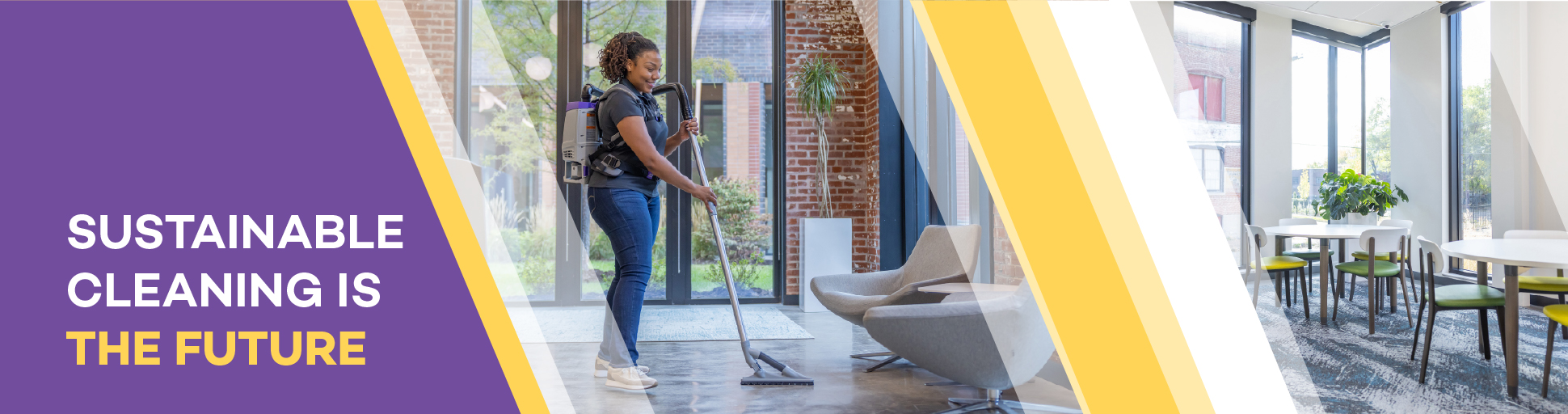
A truly sustainable program must protect workers. Traditional tools often require repetitive push-pull motions that strain the body. Ergonomic equipment, such as backpack vacuums, shifts weight to the hips, reducing physical strain by up to 50%.
When work is less physically demanding, injury rates decline, morale improves, and retention increases. This not only benefits workers but also reduces hiring and training costs for employers and improves overall service consistency.
Going Cordless for Safety
Battery-powered equipment is becoming standard as part of the transition to cleaner energy. One of its biggest advantages is safety. Power cords are a major cause of slip-and-fall accidents. Eliminating cords significantly reduces this risk.
Cordless equipment also improves productivity by allowing workers to move freely without searching for outlets. This saves time, enhances efficiency, and contributes to a safer work environment—an increasingly important consideration for both clients and insurers.
Better Air for Better Health
People spend about 90% of their time indoors, making indoor air quality critical. High-performance cleaning equipment with HEPA filtration captures up to 99.9% of fine particles, including dust, allergens, and bacteria.
By improving air quality during cleaning, organizations support healthier environments, reduce illness, and enhance productivity. For businesses, this translates into improved reputation, fewer complaints, and stronger occupant satisfaction—key drivers in today’s service-focused environment.
Buying Things That Last
Sustainability requires a long-term mindset. Durable, repairable equipment reduces waste and lowers lifecycle costs. High-quality machines typically have fewer moving parts, making them easier and less expensive to maintain.
Research shows that durable equipment may cost significantly less to maintain annually than lower-cost alternatives. Choosing equipment designed to last seven to ten years is better for both the environment and the bottom line. It reflects a strategic approach to investment and operational planning, rather than short-term cost cutting.
Conclusion: Building a More Resilient Business
Sustainable cleaning is a blueprint for making a more resilient business. In an era of rising labor costs and strict energy regulations, the engineering choices you make today determine your stability tomorrow.
Take manufacturer-recommended actions now to future-proof your operation:
- Consult with your Equipment Partner: Reach out to your vacuum manufacturer for a "Total Cost of Ownership" (TCO) analysis. Manufacturers can help you calculate the long-term savings of durable, repairable equipment compared to cheaper, disposable models.
- Transition to High-Efficiency Filtration: Standardize your fleet with HEPA-filtered backpack vacuums. Manufacturers recommend this as the most effective "engineering control" to capture microscopic pollutants and protect indoor air quality for building occupants.
- Deploy Cordless Technology: Implement battery-powered solutions in high-traffic areas. This manufacturer-led innovation is the most direct way to eliminate trip hazards and increase the "square-feet-per-hour" efficiency of your team.
- Prioritize Operator Training: Utilize the training resources provided by your manufacturer. Proper use of ergonomic harnesses and correct maintenance of filtration systems ensures your equipment performs at peak efficiency and your workers remain injury-free.
This Earth Day, let the theme “Our Power, Our Planet” serve as a call to action. By selecting equipment that is high-performing, energy-efficient, and ergonomic, you aren't just meeting a requirement—you are reducing risk, creating lasting value, and securing a healthier, more profitable future.
In our next series, we will dive deeper into Cleaning for Health® and how non-toxic products are transforming Indoor Air Quality.
Steve Ashkin
Steve Ashkin is a recognized leader in sustainability and the cleaning industry, often referred to as the “Father of Green Cleaning.” With more than 45 years of experience, he has helped shape the industry’s approach to safer products, healthier indoor environments, and more sustainable business practices. He is the Founder of The Ashkin Group, CEO of Green2Sustainable, and Co-Chair of the ISSA Sustainability Committee, a global group advancing practical sustainability solutions.
Ashkin has played major roles working with organizations including the U.S. Green Building Council, Healthy Schools Campaign, Practice Greenhealth, and the Green Sports Alliance, and has contributed to the development of LEED and WELL initiatives. He also played a key role in developing industry standards and programs such as CIMS–Green Building, EPA Safer Choice, Green Seal, and UL ECOLOGO. He was recognized by ISSA as one of the most influential members of the cleaning industry over the past 100 years.
A frequent speaker and writer, he focuses on helping companies—especially small and mid-sized organizations—use sustainability to improve performance, reduce risk, and drive business growth. He can be reached at Steve@AshkinGroup.com.
By Steve Ashkin, CEO The Ashkin Group and Co-Chair of ISSA’s Sustainability Committee[SA1]